
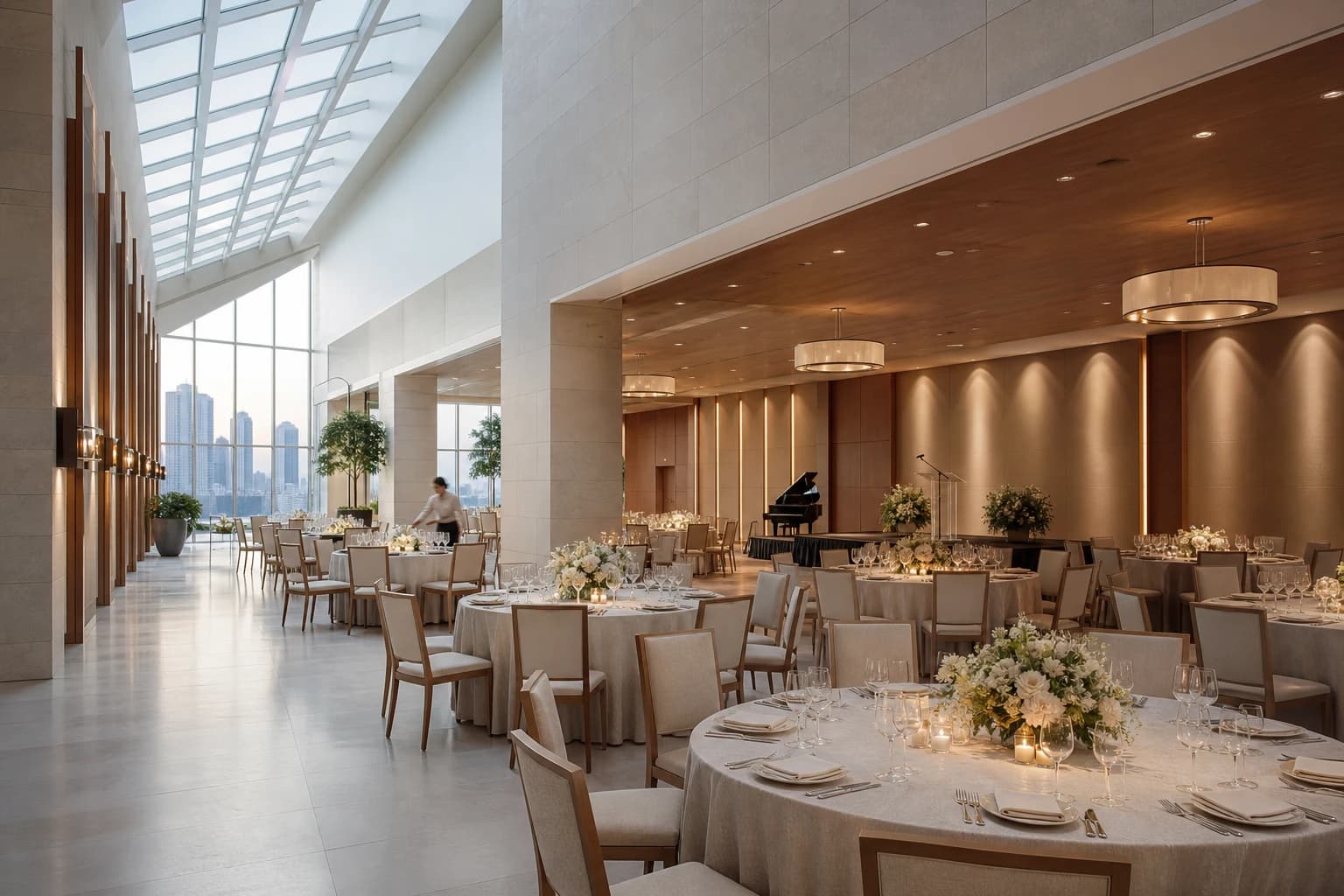
The venue
The Harbert Center sits at 2019 Fourth Avenue North in the heart of downtown Birmingham. Open since 1986, it's one of the city's established full-service event venues, five distinct spaces ranging from the sky-lit Atrium to Beeson Hall's 20-foot ceilings and stage, built to run everything from corporate meetings to galas of up to 400 guests. SFM Catering is the exclusive in-house caterer, responsible for staffing and executing every event that comes through the building, weddings on Saturday, a nonprofit gala on Tuesday, a 50-person board lunch on Wednesday, back to back with no repeat pattern.
The operational problem
Catering staffing doesn't follow a shift schedule. It follows an event calendar, and event calendars are lumpy by design. A 400-cover gala on Thursday can be followed by a dark Friday and a 60-person rehearsal dinner on Saturday. SFM has to be ready to field a full banquet crew, servers, banquet captains, setup and breakdown labor, at whatever scale that week's bookings demand, and then scale back down days later.
Carrying that peak capacity as fixed payroll doesn't work. Overstaff for the gala weeks and you're paying idle labor through the slow ones. Understaff to protect margins and the gala is the night it shows, on the floor, in front of the client who booked it. The traditional options, a fixed banquet staff sized for an average week or a rotating cast of per diem workers found through word of mouth, both break down at the volatility SFM actually operates at.
How Croux runs inside the operation
Croux works as SFM's flexible crew, scaling with the event calendar instead of against it. SFM has built Croux into how it runs every week: post the shifts an event needs, pull from a deep, vetted pool of Birmingham-area hospitality workers, and staff up or down as the calendar demands, gala one night, single-server lunch the next.
Over 44 months that's meant 919 individual shift requests posted through Croux (89% of them filled), spanning setup crews, servers, and banquet support across every kind of event The Harbert Center hosts.
Three-plus years of galas and quiet weeks
44 months is not a pilot. It's how SFM has run its staffing model since 2022. When a caterer keeps the same flexible labor source through three-plus years of unpredictable event volume, that source has become part of how the business runs.
398 distinct workers at this one venue is the depth that makes the gala weeks possible. SFM isn't relying on the same five people every time; it has access to a pool wide enough to absorb a 400-guest weekend without cannibalizing the crew needed for the next week's events.
89% fill rate and a 4% no-show rate across nearly 1,000 shifts is the day-to-day reliability that lets SFM commit to clients without hedging. Catering directors don't get graded on their average week, they get graded on whether the room was staffed for the one that mattered.
Together, roughly 11,100 hours of labor have come through Croux at this single venue, staffing that scaled up for the galas and scaled back down for the quiet weeks, without SFM carrying the payroll for either extreme.
Bring this to your venue
If your catering or event operation is staffing against an event calendar instead of a shift schedule, the fixed-payroll model is working against you. Croux gives Birmingham-area caterers and venue operators a flexible crew built for exactly that volatility. See catering and events, event staffing, and banquet staffing. Reach out to Croux to talk through what a partnership like SFM's could look like for your operation.
Related staffing pages