
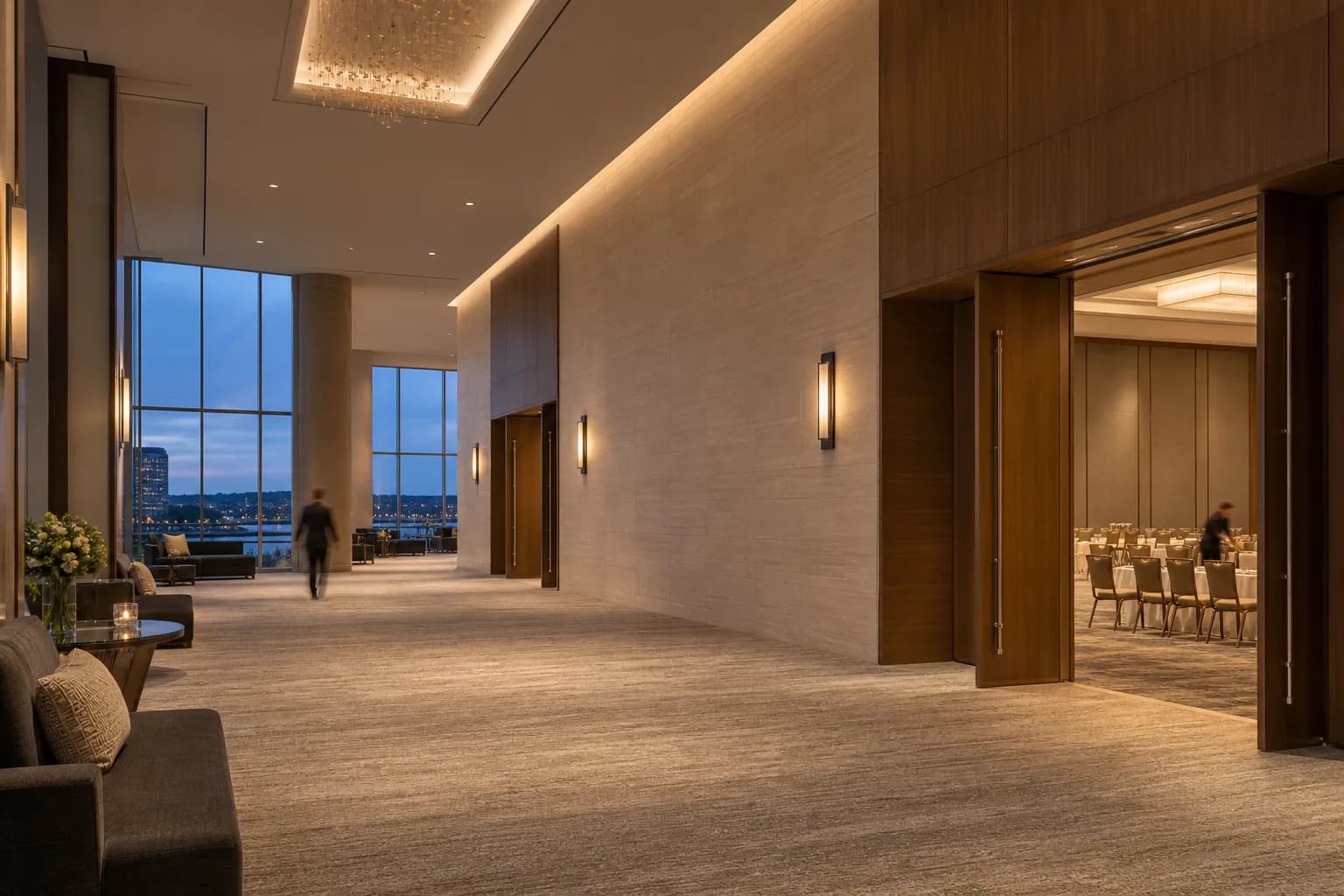
Hyatt Regency Green Bay has been posting shifts through Croux for two years, longer than any other hotel relationship in the Green Bay market. That tenure comes from a crew that has learned the property, a scheduling process that got tighter over time, and a hotel team that treats flexible staffing as a real extension of its workforce.
A hotel built for surges
Hyatt Regency Green Bay sits in downtown Green Bay, directly connected to the KI Convention Center, an almost 80,000-square-foot event space that the hotel manages and operates. The property itself runs 241 all-suite rooms with an indoor pool, on-site restaurant and bar, and a location a short drive from Lambeau Field and the Riverwalk.
That convention center attachment is the defining fact of the property's labor demand. A hotel connected to a major event venue doesn't have steady, predictable staffing needs. It has baseline needs, and then it has convention weeks, banquet turnovers, and multi-day events that spike housekeeping, banquet, and back-of-house labor well above what a lean year-round headcount can absorb. Football weekends add another layer of unpredictable surge on top of the convention calendar.
The operational problem
Hotels attached to convention centers have a staffing math problem, not a staffing effort problem. Staffing to cover the biggest banquet weeks year-round means overstaffing on the quiet weeks. Staffing to the baseline means scrambling every time a citywide event or back-to-back banquet lands on the calendar. Full-time headcount alone can't flex fast enough in either direction without either burning payroll or burning out the core team.
Hyatt Regency Green Bay needed a way to flex labor up for banquet and housekeeping surges without depending on whoever happened to be available that week, and without re-training a new face every time a shift needed covering.
How Croux runs inside the operation
Over two years, the property has posted 664 shift requests through Croux, and the same pool of workers keeps coming back. With 163 distinct workers on the property's shifts and an 85% repeat-worker rate over the full period (climbing to 89% in the trailing 12 months), the hotel isn't drawing from a fresh, unfamiliar labor pool each time. It's built a working crew that already knows the property's floor plan, banquet setup standards, and housekeeping expectations.
That familiarity shows up directly in the no-show numbers. The 24-month no-show rate sits at 2%, already low for hourly flexible labor, and it has tightened further to 1% over the trailing 12 months. A property that depends on filling banquet and housekeeping shifts around a convention schedule cannot afford a worker who doesn't show, and the trend here is moving in the right direction as the relationship matures.
Across the two-year relationship, Croux workers have staffed roughly 6,151 hours at the property, with about 3,280 of those hours in the last 12 months alone, meaning the pace of usage has held steady or grown even as reliability improved.
What this means operationally
For a GM or F&B director, the practical outcome is this: when a banquet week or a citywide event lands on the calendar, Hyatt Regency Green Bay isn't starting from zero. It's pulling from a crew of workers who have already worked the property, know the standards, and show up at a rate that keeps improving. That's the difference between staffing as a recurring fire drill and staffing as a repeatable process.
Get the same returning crew working for your property
If your hotel runs into the same surge-and-baseline math, whether it's a convention center, a stadium weekend, or a seasonal swing, you need the same thing: a returning crew that knows your property. See hotel staffing, banquet staffing, and housekeeping. Talk to our team about how a Croux crew could work inside your operation.
Related staffing pages